
About JENI
JENI is injection molding without tooling — an autonomous, continuous additive manufacturing system that produces millions of plastic parts unattended, at a cost that competes with molding. The first machine of the fourth industrial revolution. Proudly designed and assembled in the UK, with over 70% of its components made in the UK.
How JENI works
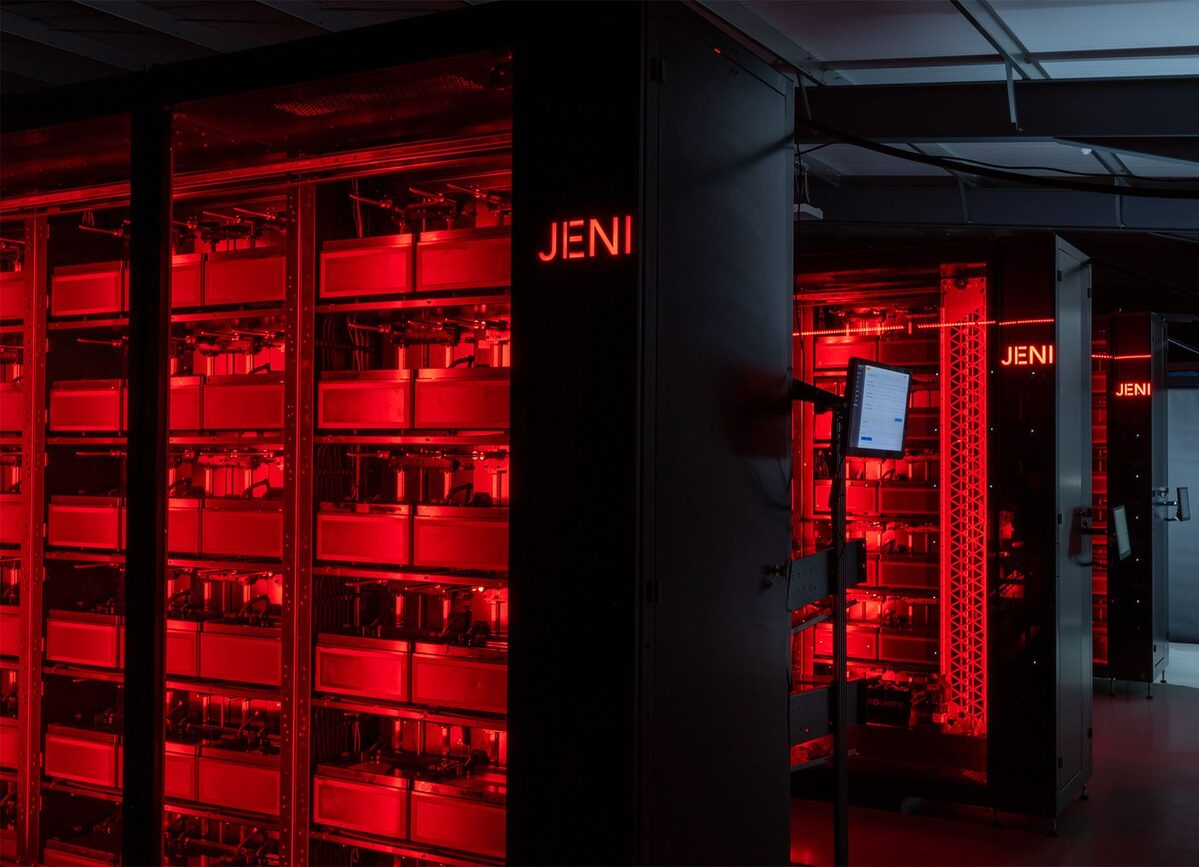
JENI automates the production of plastic parts using multiple LCD 3D print and post-processing nodes connected by high-speed robotics.
Digital file with process recipe
A digital file is sent to JENI containing customizable instructions not just for the print but for the full sequence of post-processes — wash time, cure time, temperature, and more.
Job assignment and gantry collection
JENI processes the data, monitors all nodes, and assigns the job to the next free node that matches the requirements. The gantry collects the next free print platform and moves it to the node to start.
Continuous, unattended output
Parts are delivered every 20 seconds, 24/7. Each job is treated as unique — different geometries and different processes can run simultaneously across the system.
Live production optimization
Machine learning adjusts process parameters in real time to optimize for cost, speed, carbon footprint, or quality — monitoring output quality and making tiny adjustments without human input.
What JENI is

Digital
- All processes fully tracked, recorded and controllable
- Instant digital design changes
- API for integration into external systems

Reconfigurable
- Add modules to increase production
- Change nodes within modules to perform new processes
- Run multiple products and multiple resins simultaneously

Productive
- A typical JENI creates 1 ton of product every day
- Makes anything printable
- High speed gantry moves at 3 meters per second

Accurate
- 24.8µm x 16.8µm resolution
- Patented Blow-Peel technology enables both speed and reliability
- Low force and low maintenance

Reliable
- Designed to deliver OEE consistent with best in class in injection molding
- 24-hour lights-out operation
- No human involvement

Green
- Low Carbon — 84.9% less CO2e
- Bio based resins
- Embedded carbon calculation for every part
JENI Benefits
Productivity
A platform of parts every 20 seconds, around 1 ton per day
Better Properties
Superior strength and chemical resistance
No Tooling
Rapid go to market, flexible & low start-up costs
AI-driven Process
Process optimization and predictive maintenance
Sustainability
Live carbon footprint calculation
Integration
Integration into Manufacturing Execution Systems
Scalability
Extend laterally and even vertically
Cost
Total Cost of Ownership comprises mainly of material costs
Better Products
Design for Additive Manufacturing enabled designs
24/7 Lights-Out Production
Fully autonomous operation with no manual intervention required
Specifications

Wavelength
Light output wavelength 405nm
Build volume
w= 130mm (5 1/8"), d= 225mm (8 7/8"), h= 57mm (2 1/4"), other configurations available
Productivity
Depends upon modules, typically 40kg per hour

Layer thickness
25-350µm
Pixel Pitch
24.8µm x 16.8µm
Materials
Open system with Photocentric validated grades. Resin autofill system.
Connectivity
Wi-Fi, Ethernet, USB 3.0
Software
Photocentric Conductor software with open remote API connector to other systems
Power input
Single or Three Phase depending on configuration
Machine dimensions
w= configurable by number of modules, d= 800mm (31 1/2"), h = 2440mm (96")
Resin Compatibility
JENI uses 405nm light output and is an open materials platform. Users can access our compatible advanced materials, but JENI also works with third-party resins. JENI has been validated with leading third-party resins including Henkel/Loctite, Dreve, and Forward AM.
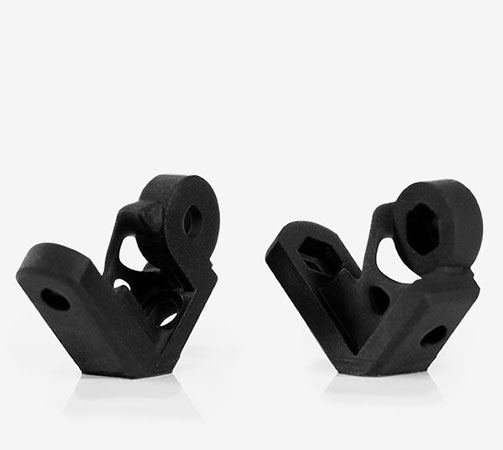
Henkel / Loctite
One platform of parts every 20 seconds
Resin: 3843 HDT60
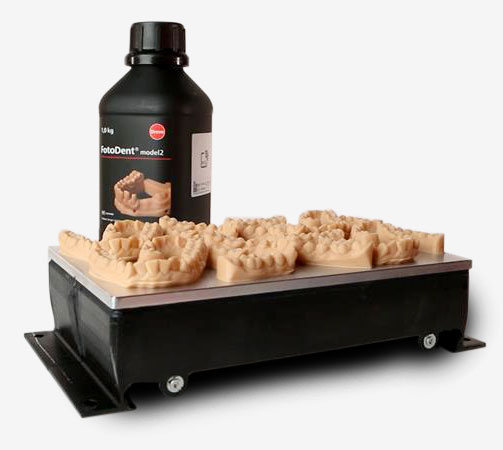
Dreve
One aligner model every 4.3 seconds
Resin: Foto Dent model2
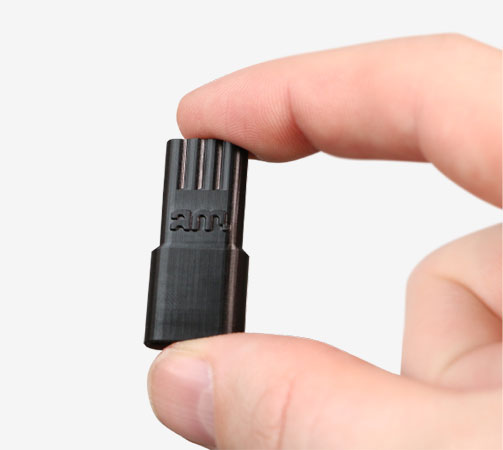
Forward AM
144 parts every 20 seconds
Resin: Ultracur3D® ST 45
The JENI Customer Journey

Evaluating Your Parts for Autonomous Production
- We start by understanding your production volumes, cost targets, and part requirements — including geometry, mechanical properties, and support needs.
- Our engineers apply Design for Additive Manufacturing (DfAM) principles to optimize each part for the JENI platform, matching your performance criteria.
- You receive a detailed Total Cost of Ownership (TCO) analysis and a Life Cycle Assessment of embedded carbon per part, so you can compare directly against your current manufacturing route.
- If JENI does not deliver a clear improvement in cost, speed, or sustainability for your application, we will tell you upfront.
- We then recommend a system configuration — number of nodes and modules — and plan every operational detail from material logistics to finished-part handling.

Is Autonomous Additive Manufacturing Right for You?
- Your daily production volume exceeds 5,000 parts.
- You need to introduce new part designs without interrupting existing production.
- You want to transition from manual 3D printing operations to fully automated, lights-out production.
- Reducing labor cost and dependency is a strategic priority.
- You require consistent part quality across high-volume runs.
- You need better-performing parts with improved surface finish.
- Lower per-part manufacturing cost is essential to your business case.
- Reducing the carbon footprint of your plastic parts production is a goal.

Deploying JENI in Your Facility
- Installation follows a structured Factory Acceptance Test (FAT) and Site Acceptance Test (SAT) process.
- You define the acceptance criteria; our engineering team works alongside yours until final sign-off — typically within one week of installation.
- We provide hands-on training for your team and ongoing service support as your long-term manufacturing partner.
Why is it called JENI?
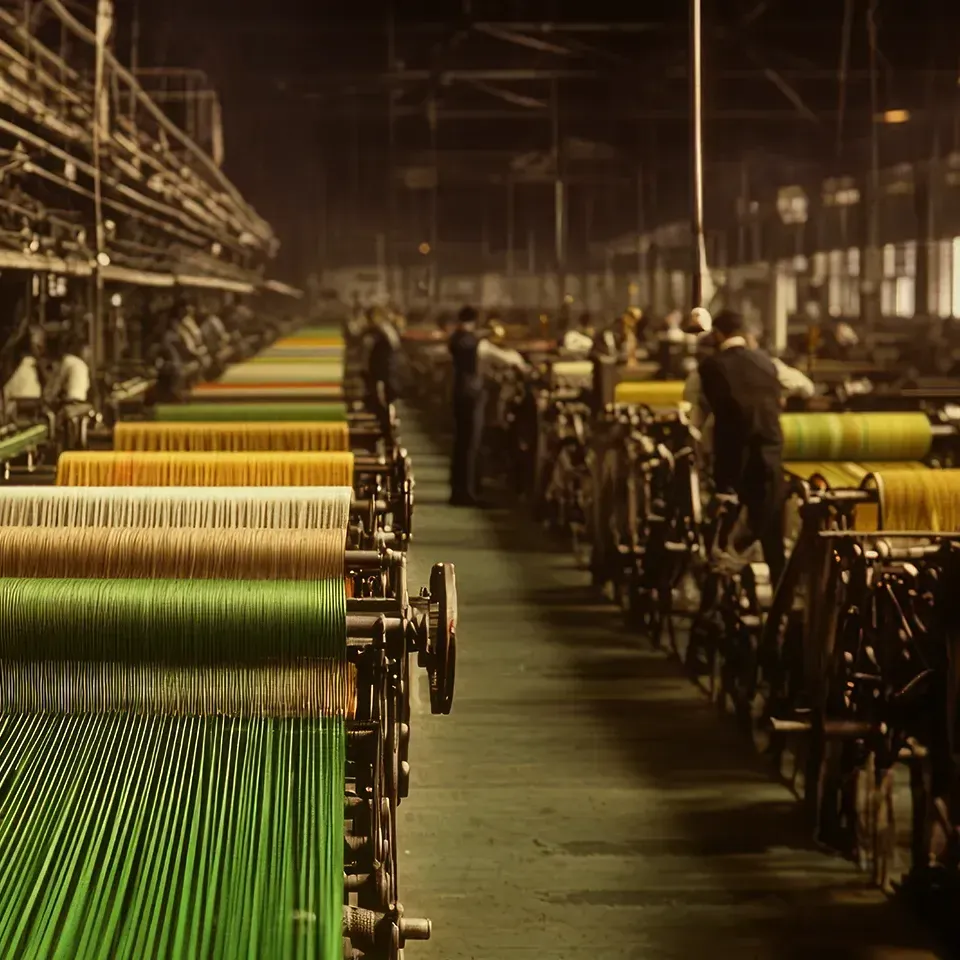
JENI is named after the spinning jenny invented in 1764 by James Hargreaves in Lancashire, England. It was the first machine of the first industrial revolution. A multi-spindle spinning frame that revolutionized textile production allowing one worker to simultaneously spin multiple threads, increasing yarn output and shifting textile work from homes to factories.
JENI is the first machine of the fourth industrial revolution, providing a paradigm shift in mass manufacturing, as the first fully autonomous, digital alternative to molding.
From LC Magna to JENI
During Covid, Photocentric ran a print farm of 52 LC Magna printers, producing over a million face shields each month. It was during that period that our engineers began thinking about how to automate the process. JENI is the result — a natural evolution that removes all the pain points of organizing production and labor across a print farm. While Magna and Titan are standalone units, JENI is fully integrated and autonomous.
Frequently Asked Questions
What resolution and layer thickness does JENI offer?
JENI has a pixel pitch of 24.8µm x 16.8µm, delivering fine features, text, and surface finish at a level most production AM cannot reach. Layer thicknesses from 25µm to 350µm are available, and each job can run at a different layer thickness even within the same system.
What is the maximum part size JENI can produce?
Each print node offers a build volume of 130mm x 225mm with a build height of 57mm. This size is optimized for the millions of small components that make up the bulk of mass plastic production. Systems with higher Z-axis can be built for specific applications.
How does JENI handle different materials on different print nodes?
JENI is an open materials platform. Each print node can run a different resin simultaneously. A dental lab could run ortho models on 6 nodes, trays on 2, crown and bridge models on another, and dentures on yet another — all at the same time.
What is the lead time for a JENI system?
JENI is available to order today with a lead time of 3 months to Factory Acceptance Test. The process starts with evaluating your parts and settling on materials, followed by on-site installation, training, and ongoing service support.
Download the JENI Leaflet
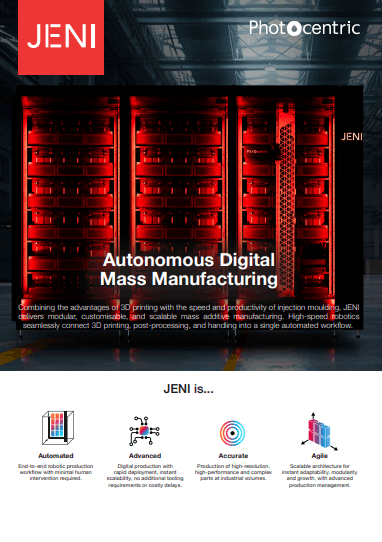
Full specifications, configurations, and capabilities in one printable PDF. No sign-up required.
Ready to rethink how you make parts?
Contact us about your application. We will evaluate your parts for JENI and compare cost and volume against injection molding.
Talk to our team