Flexible 3D printing resin is not one property or one application. A part that needs to bend once, a gasket that compresses repeatedly, and a soft grip that must recover its shape all need different behaviour. “Rubber-like” is useful shorthand, but it should never replace measurable requirements.
This guide compares flexible and rubber-like 3D printing resin by the properties that affect real parts: hardness, elongation, rebound, tear resistance, compression set, and environmental stability. You can also review current material options in the Photocentric 3D Shop.
Flexible does not automatically mean rubber-like
A flexible resin may deflect under load but still behave like a tough plastic. A rubber-like or elastomeric resin is typically chosen when the part needs a softer feel, repeated recovery, compression, or grip. The boundary depends on the formulation and the test method, which is why Shore hardness and elongation should be read together.
Start by describing the action the part must perform: bend, compress, stretch, seal, cushion, grip, or absorb vibration. That description gives the resin supplier a meaningful target and avoids selecting a material from a marketing adjective alone.
The properties that matter
- Hardness: A Shore value helps compare softness, but it does not predict every aspect of part performance.
- Elongation at break: This indicates how far a material can stretch before failure, but test geometry and print direction still matter.
- Tear strength: Critical for thin edges, seals, grips, and parts with notches or cut-outs.
- Rebound: Important when the part must recover quickly after compression or impact.
- Compression set: A key sealing property that describes permanent deformation after sustained compression.
- Chemical and temperature resistance: Oils, cleaners, UV exposure, and heat can change flexibility over time.
Flexible resin application guide
Seals and gaskets
Seals need controlled compression, tear resistance, and low compression set. Pay attention to wall thickness, sealing surface quality, and the media the part will contact. A softer resin is not automatically a better seal if it creeps under load.
Grips and soft-touch components
For handles and grips, tactile feel, abrasion resistance, and surface texture may matter more than maximum elongation. Test the part in the user’s hand and after repeated cleaning or handling.
Vibration and impact features
For damping, compare energy absorption and recovery rather than simply choosing the softest material. Geometry often contributes as much to performance as resin selection, so prototype the complete feature.
Living hinges and flexures
Repeated bending demands careful attention to print orientation, hinge radius, thickness, and cycle count. A flexible resin may work for a prototype while a tougher or more elastic grade is needed for production.
Design and post-processing considerations
Flexible parts can be more sensitive to supports and handling than rigid parts. Place supports away from sealing, gripping, and moving surfaces where possible. Wash thoroughly, remove supports carefully, and follow the recommended cure schedule. Under-cured resin may feel soft but can remain tacky or change properties in service.
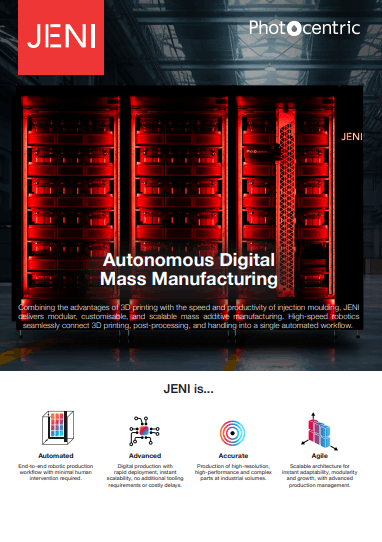
For automated production on JENI, the advantage is repeatability: the print, wash, and cure parameters are carried with the job. That makes it easier to keep a flexible part’s feel and performance consistent across a production run.
How to choose the right flexible resin
- Describe the deformation and recovery the part must perform.
- Set hardness, elongation, tear, and compression targets.
- List temperature, chemical, UV, and cleaning exposure.
- Design and print a representative test coupon or finished part.
- Test after the complete wash and cure process, including repeated loading.
Make the choice with a finished part
The right flexible 3D printing resin is the one that delivers the required movement and durability in the finished geometry. Compare data sheets, but make the decision with a representative part and a realistic test. Explore available materials in the Photocentric 3D Shop.