The case against additive manufacturing at volume was never really about printing. It was about everything around the printer: the labor, the handling, the inconsistency between one batch and the next, and the price of the material. When a customer builds JENI into a full production costing — material, labor, energy, tooling, scrap, storage, obsolescence, and the cost of not having the right part when it is needed — the answer has repeatedly come out in favor of printing, and by a wider margin than we expected.
The hidden costs of injection molding
Tooling has been the gatekeeper of mass plastic production for a century. A steel mold can cost tens of thousands of dollars, takes weeks or months to produce, and fixes the design for the life of that tool. It sets the minimum order quantity — because you need to amortize the tool cost across enough parts to make the unit cost viable. It decides which parts are worth making at all.
But the costs do not stop at the mold. Injection molding consumes considerably more material than the part weighs — sprues, runners, start-up, and purging scrap. For high-variation molding, this waste is especially significant. Parts are often produced speculatively to meet minimum order quantities and later written off. Storage costs accumulate. And when a design needs to change, the tool has to be re-cut or replaced entirely.
What JENI eliminates
JENI removes the tooling cost entirely. There is no mold to design, manufacture, ship, maintain, or store. There is no minimum order quantity — you can produce one part or one million. Design changes are a file update, not a tool modification.
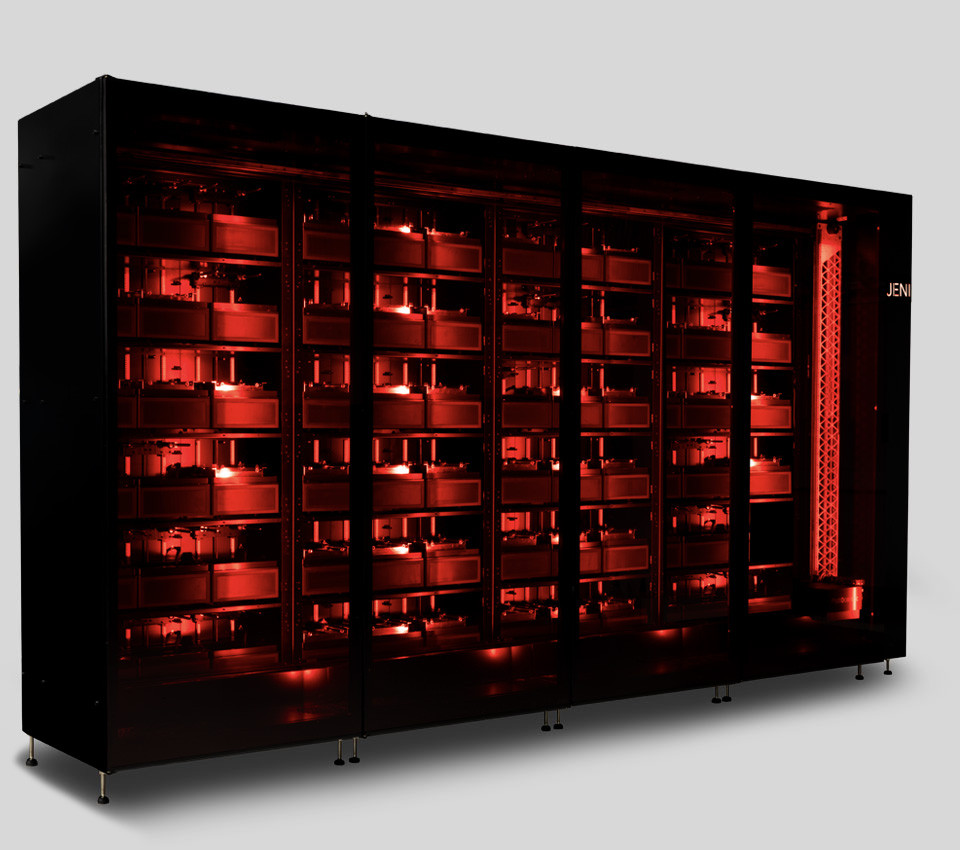
JENI also eliminates most of the labor cost. The system runs continuously and unattended, 24/7. Each job carries its own process recipe, and the gantry automatically moves print platforms between nodes. Most customers connect JENI to IBCs of resin that are changed every few days. The only human involvement is occasional maintenance and a short downstream step to prepare parts for end use.
Material cost: the deciding factor
The biggest objection to additive manufacturing at volume has always been material cost. Photopolymer resins have historically been far more expensive per kilogram than injection molding pellets. But this comparison misses two things.
First, Photocentric formulates its own photopolymers and has been making them for over 20 years. Because we make both the material and the machine, we can qualify chemistries against real production parts on JENI rather than validating them in isolation. This gives us two advantages: cost competitive against Far East supply, and direct control over the quality of the resin.
Second, JENI packs platforms densely with minimal support structure, and uncured resin drained from platforms returns straight to the vat. Process scrap is low by design. In injection molding, the material waste from sprues and runners is significant — and for high-variation molding, it can be a large fraction of the total material consumed.
The evidence: parts that should not work
The clearest evidence is the kind of part now being made on JENI. We have customers printing millions of some of the lowest-value parts — components where fractions of a penny or cent decide the business case, and their own costings say JENI works. That is precisely the test additive manufacturing has always been told it would fail.
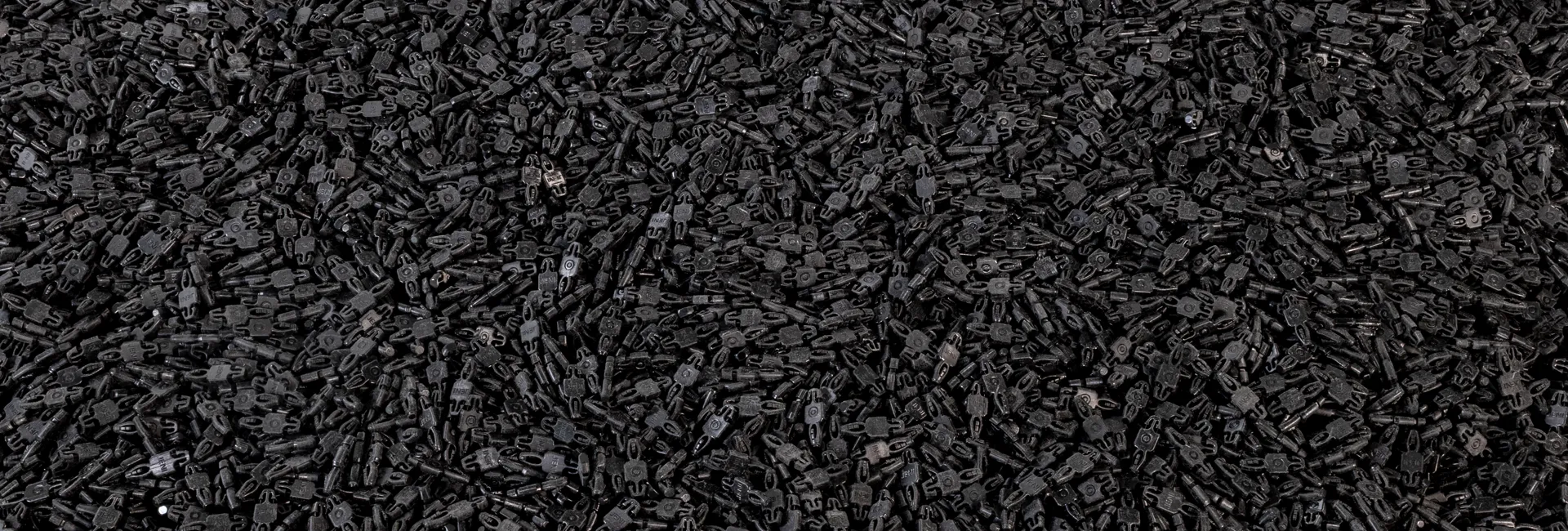
Our own engineering team prints literally thousands of parts within JENI to solve stock and lead-time issues with existing suppliers. Recently, they printed a bed of cable grommets — they cost $0.18 off the shelf, but it is easier and faster to design and print the parts on JENI rather than order externally.
Beyond unit cost: the full costing picture
When companies compare JENI to injection molding, the most revealing exercise is to build a full production costing rather than comparing unit price alone. Here is what that costing includes:
- Material: Resin cost per part, accounting for near-zero process scrap on JENI versus sprue and runner waste in molding.
- Labour: Minimal on JENI (unattended operation) versus machine tending and batch handling in molding.
- Energy: LCD screens cure an entire layer in one exposure, making JENI lower in energy use than other AM methods and competitive with molding.
- Tooling: Zero on JENI. In molding, the tool cost is amortized across the batch — and for low-volume or high-variation parts, this dominates the unit cost.
- Scrap: Low on JENI by design. Moulding generates start-up and purging scrap, especially during color or material changes.
- Storage: JENI produces on demand, so you do not store parts that may become obsolete. Moulding's minimum order quantities force inventory holding.
- Obsolescence: Parts produced speculatively to meet MOQs that are later written off — a cost that does not exist with JENI's on-demand model.
- Availability: The cost of not having the right part when the customer needs it. JENI's digital inventory means any part can be produced on demand.
The result
We are not able to share the specifics of any customer's parts or costings. What we can say is that the cost picture has genuinely surprised us. The answer has repeatedly come out in favor of printing, and by a wider margin than we expected. When the full costing is built — not just material per gram, but the total cost of producing and holding parts — JENI competes with injection molding and wins.
Read more about how JENI works as injection molding without tooling and the 85% CO2 reduction JENI achieves per part.