For thirty years, additive manufacturing has been paid a compliment that is really a limit: brilliant for prototypes, brilliant for the complicated and the bespoke, but never for the parts the world actually runs on. The clips, caps, connectors and grommets. The billions of small, dull, essential components that hold every product together, and that only a steel mold was ever supposed to be able to make.
We think that assumption is now out of date, and JENI is the reason.
The case against additive at volume was never about printing
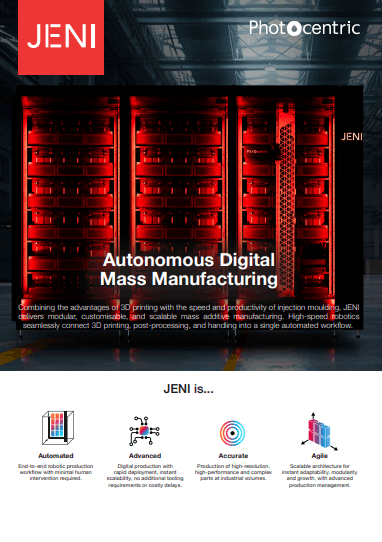
It was about everything around the printer: the labor, the handling, the inconsistency between one batch and the next, and the price of the material. Take those away and the arithmetic changes. JENI runs continuously and unattended, every job carrying its own process recipe rather than repeating a fixed one, on materials we formulate ourselves at a price that stands up against molding.
That is what makes this a new chapter rather than a better printer. Tooling has been the gatekeeper of mass plastic production for a century: it sets the minimum order quantity, it fixes the design, it decides which parts are worth making at all. JENI removes the gate.
How JENI works
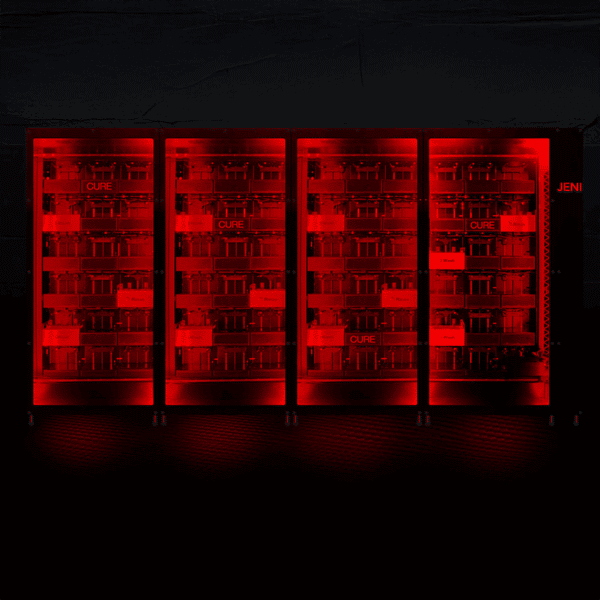
A digital file is sent to JENI that contains all the customizable instructions not just for a print but for the full sequences of post processes that the print needs to go through — wash time, cure time, temperature, and more. JENI processes that data, monitors all the nodes in the system, and assigns the job to the next free node that matches the job requirements. The gantry collects the next free print platform and moves it to the node to start the job.
This architecture is unusual. Conventional automation has a standard "recipe" which is performed over and over again, whereas JENI treats every job as unique. This allows us to not only produce completely different geometries for every print, but also completely different processes for each print. It gives JENI the ability to use machine learning to optimize the process a job goes through — for cost, speed, carbon footprint, or quality — by making tiny adjustments in the input process parameters and monitoring the quality of the part output. Essentially, live production optimization without human input.
What JENI can produce
A JENI system is modular and can scale to be just about any size or output. The largest installation to date is 16 modules with 288 nodes, which can produce 148,000 parts per day at around 40mm in size with 14 parts per print.
Another customer uses a single-module system — about the size of a typical wardrobe — that produces 1.2 million extremely accurate parts per day with 780 parts per print. The gap between those two figures is down to part size and nesting rather than system size: 780 small parts on a platform against 14 larger ones.
The numbers are extraordinary for additive manufacturing and are why we say that JENI should be looked at as an alternative to injection molding. We are happy to evaluate customer parts to compare JENI to injection molding for cost and volume per day.
Resolution and part quality
Pixel pitch is 24.8µm x 16.8µm, so fine features, text, and surface finish are at a level most production additive manufacturing cannot reach — or would need extra finishing to achieve. Part finish is essentially on a par with injection molding. We recently ran a jewelry application that exceeded the quality of every other printer the customer had tried.
Layer thickness: the traditional 25, 50, and 100µm layers are all available, plus anything in between and up to 250µm. Because each job carries its own parameters, two parts running in the same system at the same time can print at different layer thicknesses.
Part complexity is effectively unlimited. There are no draft angles, split lines, ejector pin marks, or restrictions on undercuts or internal geometry. A complex part costs no more to produce than a simple one of the same volume. The same goes for surface texture — fine grains, patterns, and decorative finishes are free on JENI, where in molding they have to be cut into the tool at considerable expense and are then fixed for the life of that tool.
Running 24-hour lights-out
For JENI itself, very little human oversight is needed. Most customers connect them to IBCs of resin, which are changed every few days. There is sometimes some maintenance to do on the nodes, but it is very little. We focused a lot on reliability in JENI — automation really struggles with part failure, so we made the machines as robust as we could.
JENI delivers finished parts. From there, most customers add a short downstream step to get them ready for their end use — adding extra parts, sorting, or packing. In very high-volume applications, we learned early on to size that downstream capacity to match JENI, rather than let parts buffer up overnight. When a JENI is producing one platform of parts every 20 seconds, you get 2,880 platforms in the 16 hours of downtime. That is enough to fill a small warehouse — which is why the downstream line is worth running in step with the printer.
Who is JENI for?
Target customers are companies who need to make a lot of smallish plastic parts — they could be fed up with the costs of having molds in multiple locations, costs of storage of parts that may become obsolete, costs of not having the right size of part in stock when the customer needs it, or the flexibility to customize quickly without adding cost. The first adopters are innovators within large companies who traditionally use injection molding as well as our existing 3D printing user base.
We joke in the office about JENI expanding the market for 3D printing from the exciting applications like dental models, footwear, miniatures, and jewelry — all of which are still serviced by JENI — and making it cost-effective to now print the "boring parts": clips, knobs, connectors, and caps. The parts the world runs on.
Every JENI installation starts with a customer's own applications, and no two are the same. Transitioning a production line from traditional manufacturing to a digital process takes close collaboration between our technical team and theirs. This is not box shifting. We are taking on a customer's manufacturing challenge alongside them.
Available to order today
JENI is available to order today with a lead time of 3 months to Factory Acceptance Test. It also depends on how fast a company can test parts and settle on the materials it needs — that validation happens before the order is placed. In the Site Acceptance Test, we install on site, run the system off against their parts, train their team, and then support it under an ongoing service agreement.
For thirty years additive manufacturing has been told it will never make the parts the world actually runs on. We have never accepted that. JENI exists because we believe those parts can be made digitally, without tooling, at volume, at a competitive price, and with a fraction of the carbon. That is not a prototyping story or a niche application story. It is manufacturing in 2026.
Learn more about the real cost comparison between additive manufacturing and injection molding and how JENI achieves an 85% CO2 reduction per part. For full technical details, visit the about JENI page.