Choosing compatible resin for JENI is an application decision, not a search for one universal “best” 3D printer resin. JENI is built to run different photopolymers across its print nodes, but each part still needs the right balance of strength, flexibility, heat resistance, surface finish, accuracy, cure behaviour, and cost.
This guide gives manufacturing teams a practical way to match LCD 3D printer resin to the application and the production workflow. To browse available materials, visit the Photocentric 3D Shop. For a specific part, Photocentric can help validate the material and process window.
Start with the application requirements
Write the requirements before looking at resin names. A resin for a high-volume electronics standoff may prioritise speed, accuracy, and dimensional stability. A resin for a seal may prioritise flexibility, tear resistance, and compression recovery. A resin for a warm fixture may need heat resistance and low creep.
- Mechanical: stiffness, impact strength, elongation, tear resistance, and fatigue.
- Thermal: continuous temperature, short-term peaks, thermal cycles, and load at temperature.
- Environmental: water, oils, solvents, UV, cleaning agents, and humidity.
- Visual: colour, opacity, clarity, surface texture, and cosmetic consistency.
- Process: layer thickness, wash time, cure temperature, support strategy, and production rate.
- Commercial: material cost, availability, quality documentation, and repeatability.
Common resin families and where they fit
Rigid and tough resins
Rigid grades suit clips, housings, brackets, connectors, and other parts that need dimensional stability. Tougher formulations are useful when the part sees impact, snap-fit assembly, or repeated handling. Select between stiffness and toughness based on the failure mode you need to avoid.
Flexible and elastomeric resins
Flexible 3D printing resin can support seals, grips, protective covers, damping features, and soft-touch components. Compare hardness, elongation, tear strength, rebound, and compression set rather than choosing solely by the word flexible.
Clear and transparent resins
Clear resin is useful for windows, housings, light guides, visual prototypes, and fluid-flow models. Optical appearance depends on geometry and finishing as well as chemistry, so validate the final washed, cured, and polished part.
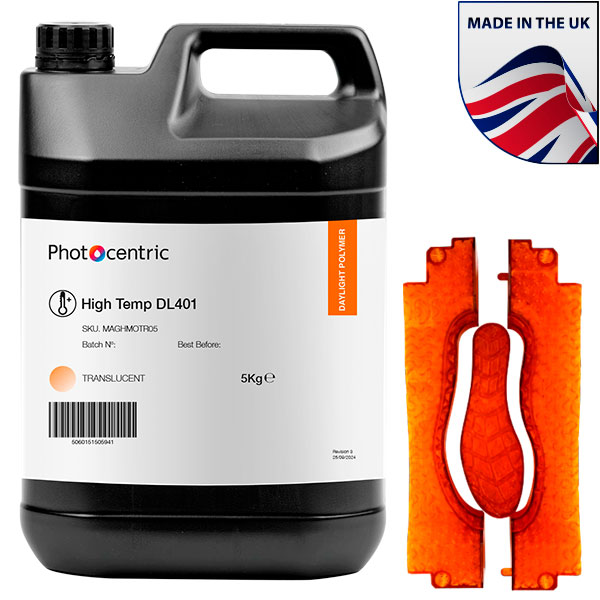
Heat-resistant resins
For warm fixtures, housings, and process tools, compare heat deflection, glass transition, creep, and dimensional stability. Always test the finished part under its real load and exposure time.
Bio-based and sustainability-focused options
Where carbon impact or renewable content matters, compare the material’s lifecycle evidence, bio-derived content, process scrap, and production energy together. A material claim is strongest when it is connected to measured production data.
Why process compatibility matters
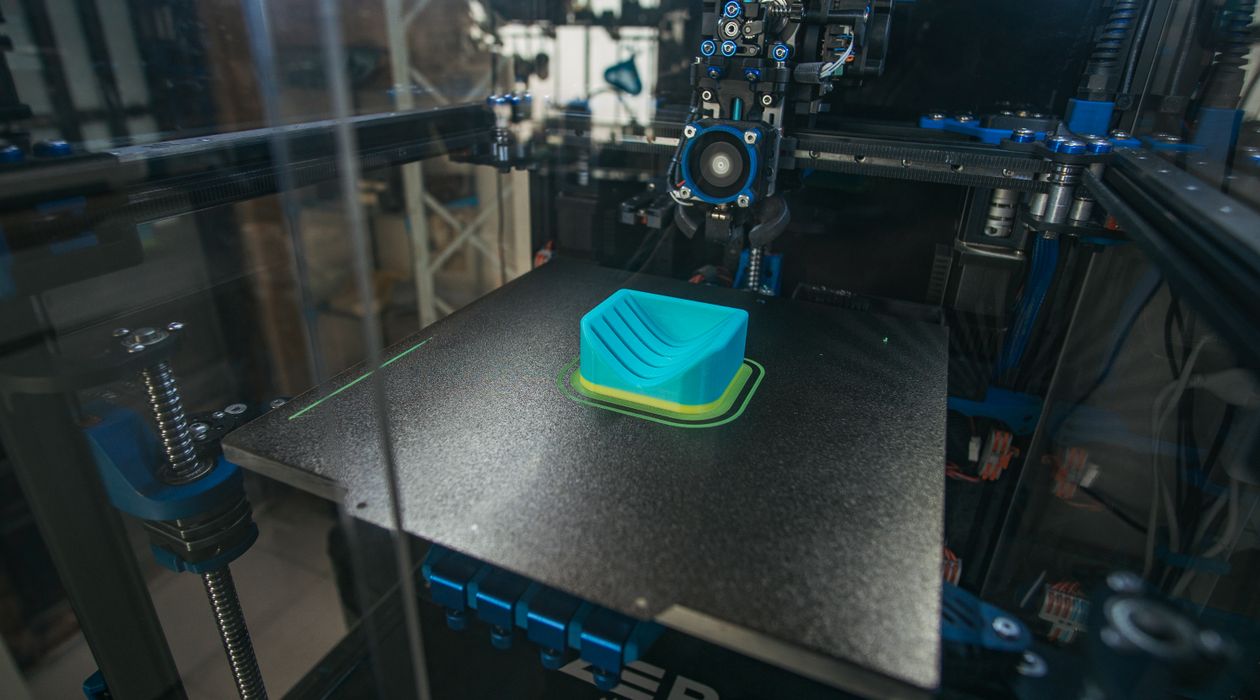
A resin is compatible with JENI only when it can be printed, washed, cured, and handled reliably in the intended production recipe. The same chemistry can behave differently when layer thickness, exposure, platform packing, wash time, or cure temperature changes. That is why a material evaluation should use the actual geometry, nesting, and throughput target.
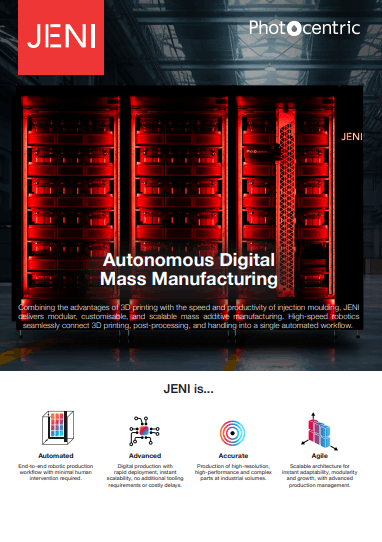
JENI’s architecture makes mixed production possible: different nodes can use different resins and job-specific recipes at the same time. This avoids a material changeover whenever a production schedule moves from a rigid component to a flexible one, while preserving the process window for each job.
Production validation checklist
- Send the part geometry, expected volume, and end-use requirements for review.
- Select a shortlist of compatible Photocentric materials.
- Print representative parts using the intended layer and nesting strategy.
- Wash and cure with the production recipe, then measure dimensions and properties.
- Test the part under real load, temperature, chemicals, and cycle count.
- Confirm documentation, supply, cost per part, and repeatability before release.
Choose the resin and the process together
The best resin for JENI is the one that meets the application requirements within a repeatable production window. Material selection, job recipe, nesting, post-processing, and downstream handling should be validated as one system. Browse Photocentric resin options in the 3D Shop, or contact the team to discuss a specific JENI application.