Resin 3D printing has spent a decade being underestimated. The technology that could produce a jewelry master pattern or a dental model with extraordinary detail was dismissed as too slow, too labor-intensive, and too expensive for anything labelled "production." That dismissal was correct — for a standalone printer. It is no longer correct for an automated system.
The difference is not a better printer. It is everything around the printer: the handling, the post-processing, the scheduling, the material management, and the reliable engineering that allows resin printing to run continuously, unattended, at a cost per part that competes with injection molding. This article explains what automated resin 3D printing actually means in an industrial context, what it requires, and where the boundary between prototyping and production now sits.
What "automated resin printing" means
A standalone resin printer — whether LCD, DLP, or SLA — follows a simple cycle: an operator loads a build platform, starts the print, removes the platform when the print is done, washes the part in solvent, cures it under UV light, and separates the finished parts from the platform. Each step is manual. Each step takes time. And each step introduces variability — one operator washes for ten minutes, another for fifteen, and the part properties differ.
Automated resin printing eliminates every one of those manual steps. In JENI, the process works as follows: a digital file containing the print geometry and the full process recipe — wash time, cure time, temperature, layer thickness — is sent to the system. JENI processes that data, monitors all print nodes, and assigns the job to the next free node that matches the requirements. A high-speed gantry running at 3 meters per second collects the next free print platform, moves it to the assigned node, and starts the job. When the print completes, the gantry moves the platform to the post-processing stations, and returns a clean platform to the next free node.
The critical distinction is that the system treats every job as unique. Conventional automation repeats a fixed recipe over and over. JENI carries a job-specific recipe for each build, which means different geometries and different process parameters can run simultaneously across different nodes — with no changeover downtime.
Why automation changes the economics
The cost structure of standalone resin printing is dominated by labor. Even a skilled operator managing a rack of printers spends most of their time washing, curing, and separating parts — work that does not scale with printer count. Double the printers and you roughly double the labor, or you accept quality variation as the operator rushes to keep up.
Automated resin printing inverts that ratio. In JENI, labor is negligible: the system runs 24/7 with no operator present. The dominant cost becomes material, which means the economics improve as material cost per part falls — through denser platform packing, faster layer curing, and lower resin prices from in-house formulation. This is why the cost per part for small components on JENI is competitive with injection molding, even before tooling cost is considered.
The second economic factor is utilization. A standalone printer that runs one build and then sits idle while the operator post-processes it might achieve 40% utilization. JENI achieves near-continuous utilization because the gantry keeps every node fed with work — a finished platform comes out, a new one goes in, and the node never waits.
The technology: LCD resin printing at production scale
JENI uses LCD (Liquid Crystal Display) resin printing, in which a UV light source cures photopolymer resin layer by layer through an LCD mask that defines each layer's geometry. The technology offers several advantages for production:
- Resolution: Pixel pitch of 24.8µm × 16.8µm, producing fine features, text, and surface finish at a level most production additive manufacturing cannot reach without secondary finishing.
- Layer flexibility: Traditional 25, 50, and 100µm layers are available, plus anything in between and up to 250µm. Two parts running on different nodes can print at different layer thicknesses simultaneously.
- Build volume per node: 130mm × 225mm with 57mm build height, accommodating a wide range of small components with dense nesting.
- Material range: Each node can run a different resin, from rigid engineering grades to flexible polymers to bio-based formulations, with no changeover time or purge waste.
The limitation of LCD printing — and of all vat photopolymerization — is part size. Photocentric has large format LCD printers (like LC Magna and LC Titan) but JENI is currently designed for components that fit within the 130mm × 225mm × 57mm build envelope. For the billions of small plastic parts the world runs on — clips, caps, connectors, grommets, spacers — this is not a constraint. For large structural parts, it is.
Throughput: what the numbers actually mean
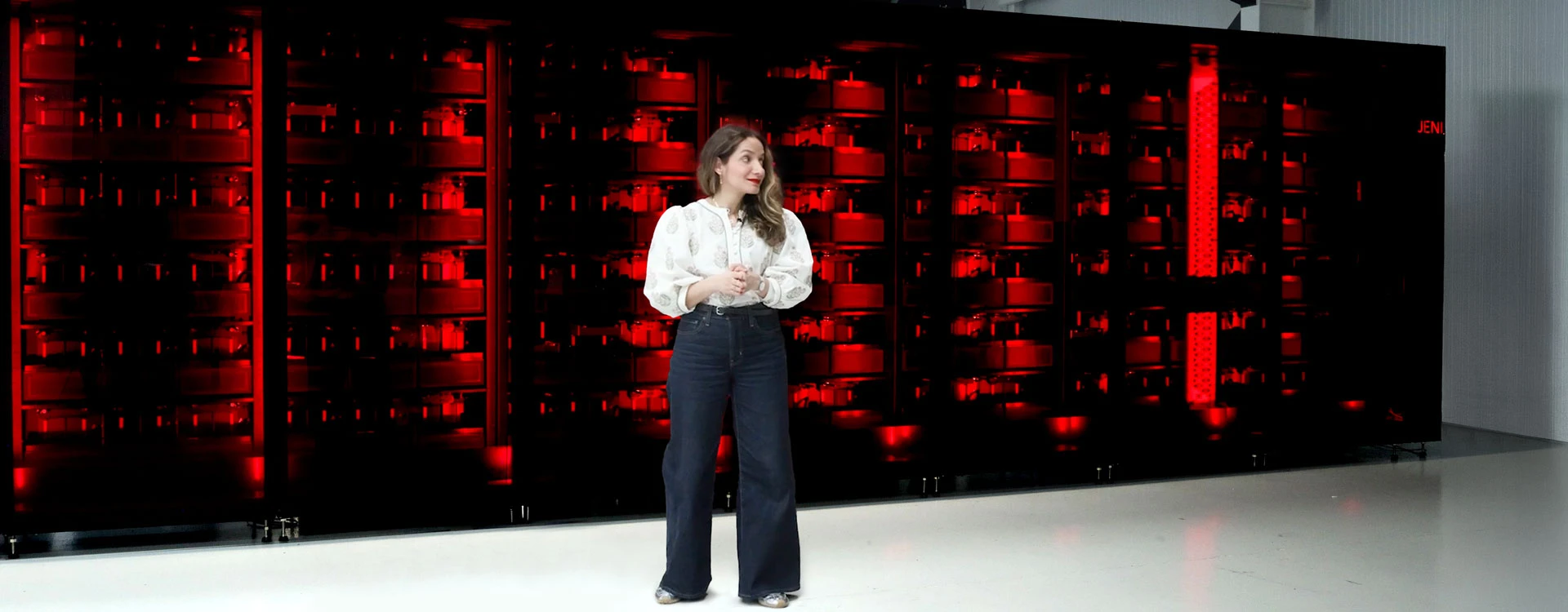
Throughput in automated resin printing is a function of three variables: parts per platform, platform cycle time, and number of active nodes. JENI can deliver a finished platform of parts every 20 seconds in continuous output. A single-module system with 780 parts per platform can produce up to 1.2 million parts per day. The largest installation — 16 modules with 288 nodes — can produce up to 148,000 parts per day at around 40mm in size with 14 parts per platform.
These are not theoretical maxima. They reflect real production data from configured systems running specific part geometries. Smaller parts with denser packing yield higher counts; larger parts yield fewer. The point is that the platform scales horizontally — more nodes means proportionally more output — without the step-change in cost and complexity that comes with commissioning a new molding press and tool.
What makes JENI different from a print farm
A print farm — a room full of standalone printers — is the most common attempt to scale resin printing. It does not work for production, for three reasons:
- Labor does not scale: 124 standalone printers still need operators to load, unload, wash, and cure. JENI's gantry handles all of that automatically.
- Quality is inconsistent: Manual post-processing introduces variability. JENI's automated, recipe-driven post-processing is repeatable.
- Utilization is low: Standalone printers sit idle between builds. JENI keeps every node continuously fed, achieving near-100% utilization.
The difference is architectural. A print farm scales printers; JENI scales a system. Some print farm owners may add some automation with a robot arm to move build plates from printer to wash or cure. JENI provides high speed robotics to seamlessly connect all work stations into a single automated workflow. The gantry, the recipe management, the machine-learning optimization, and the automated post-processing are what turn resin printing from a benchtop process into an industrial one.
Machine learning and live production optimization
Because every job carries its own process recipe, JENI can make tiny adjustments to input process parameters — wash time, cure temperature, exposure — and monitor the quality of the part output. Over thousands of builds, the system learns which parameter combinations produce the best results for a given geometry and material, optimizing for cost, speed, carbon footprint, or quality depending on the priority set for each job.
This is live production optimization without human input. It is not possible in a print farm because there is no automated feedback loop between part quality and process parameters — the operator does not adjust wash time based on the dimensional accuracy of the last batch. In JENI, that loop is closed.
Who should evaluate automated resin printing
Automated resin 3D printing is not a universal replacement for injection molding. It is a production route for a specific category of parts: small plastic components, typically under 130mm in their longest dimension, produced in high volumes, where design changes are frequent or tooling cost cannot be justified.
Manufacturers who should evaluate it include:
- Electronics and electrical — standoffs, clips, connectors, and insulators produced in high volume with frequent design iterations.
- Medical and dental — custom or batch production where multiple resin types and geometries run side by side on the same system.
- Automotive — bridge manufacturing between design finalization and tool delivery, plus low-volume end-use parts where tooling is not justified.
- Consumer goods — caps, closures, and small mechanical components where customization or rapid design changes matter.
The bottom line
Automated resin 3D printing has crossed from prototyping to production. The technology that could always produce beautiful parts can now produce them continuously, unattended, at a cost that competes with molding — without tooling, without minimum order quantities, and without the fixed design that a mold imposes. That is not a better printer. It is a different category of manufacturing.
Learn more about the practical requirements for running resin printing lights-out and how the 7-module JENI configuration delivers 1.2 million parts per shift. For the full cost framework, see how to calculate production 3D printing cost per part.