"Lights-out" is one of the most used and least understood terms in manufacturing. It does not mean turning off the lights and hoping the machines keep running! It means a production system engineered to operate continuously, unattended, with the reliability, material handling, and monitoring infrastructure to make that safe and productive. In resin 3D printing, the gap between a standalone printer that runs one build and a lights-out system that runs 24/7 is enormous — and most of that gap is engineering.
This article sets out the practical requirements for lights-out resin printing at production scale, based on what JENI installations actually need to run. It is written for manufacturing engineers and operations leaders evaluating whether autonomous additive production is feasible for their facility.
Requirement 1: Automated material supply
A standalone resin printer has a vat that holds perhaps 100 to 200ml of resin. An operator tops it up periodically. In lights-out operation, there is no operator to top up the vat. The system must draw from a bulk supply that lasts days, not hours.
Most JENI customers connect their systems to 800L IBCs (Intermediate Bulk Containers) of resin, which are changed every few days. The system monitors resin levels and alerts for scheduled refills — it does not stop when a single vat runs low, because multiple nodes share a supply and the system reroutes work to nodes with adequate material. Uncured resin is returned to the vat after each print, so material waste is minimal by design.
The practical implication: a lights-out resin printing installation needs bulk material storage, pumped delivery to each node, and a monitoring system that tracks consumption. Without this, the system stops every few hours for a refill — which is not lights-out.
Requirement 2: Integrated post-processing
Printing is only the first step. Most resin-printed parts must be washed to remove uncured resin and then UV-cured to achieve final mechanical properties. In a standalone setup, these steps are manual. In lights-out operation, they must be fully automated and integrated with the print nodes.
JENI integrates washing and curing as automated stations within the system. The gantry moves each finished print platform from the print node to the wash station, then to the cure station, then to a separation step where parts are removed from the platform — all without human intervention. Each job's process recipe defines the wash time, cure time, and temperature for that specific part and material, so post-processing parameters are repeatable and optimized rather than left to operator judgment.
The practical implication: post-processing cannot be an afterthought or a separate manual step. It must be built into the system architecture, with the same level of automation and recipe control as the printing itself. JENI is configurable so nodes for different functions can also be added.
Requirement 3: Reliability engineering
This is the requirement that separates genuine lights-out systems from aspirational ones. In lights-out operation, a node failure does not just stop one build — it reduces throughput until someone arrives to fix it. If failures happen frequently enough, the system spends more time down than up, and the economics collapse.
JENI addresses reliability at multiple levels:
- Robust node design: Print nodes are engineered for continuous duty cycles, with components rated for 24/7 operation. Automation struggles with part failure, so the machines are built to minimize it.
- Continuous monitoring: Sensor systems monitor system parameters throughout the JENI (forces, environmental conditions, resin & solvent condition, light output etc) as well as printed part quality.
- Automated reaction: Any node outside its set parameters or a printed part detected below quality limits can trigger individual nodes to be marked for maintenance whilst the remaining system can continue to operate.
- Failure prediction: By analysing the system data and using machine learning to correlate it with part quality, the system can adapt or schedule predictive maintenance to optimise quality and throughput.
The practical implication: lights-out operation is not achieved by buying a robot and attaching it to a printer. It requires a system designed and validated for the reliability demands of continuous unattended operation.
Requirement 4: Downstream capacity matching
This is the requirement that catches most new JENI customers by surprise. When a system can produce a platform of finished parts every 20 seconds, the output volume during unattended hours is substantial. In the 16 hours of overnight downtime (assuming a single day shift for downstream operations), that is 2,880 platforms of parts — enough to fill a small warehouse.
The solution is to size downstream capacity — sorting, packing, assembly, or any secondary operation — to match JENI's output rather than letting parts buffer up overnight.
The practical implication: lights-out printing is only useful if the rest of your operation can absorb the output. Plan the full flow, not just the printer.
Requirement 5: Maintenance strategy
Lights-out does not mean zero maintenance. It means maintenance is scheduled, not reactive. JENI nodes need occasional maintenance — cleaning, component replacement, calibration — but the volume is low, and the system's monitoring allows it to be planned during downtime rather than triggered by a failure.
The practical implication: allocate maintenance resources based on system data, not on a fixed schedule. The system tells you when a node needs attention; you do not need to inspect every node every day.
What a working lights-out installation looks like
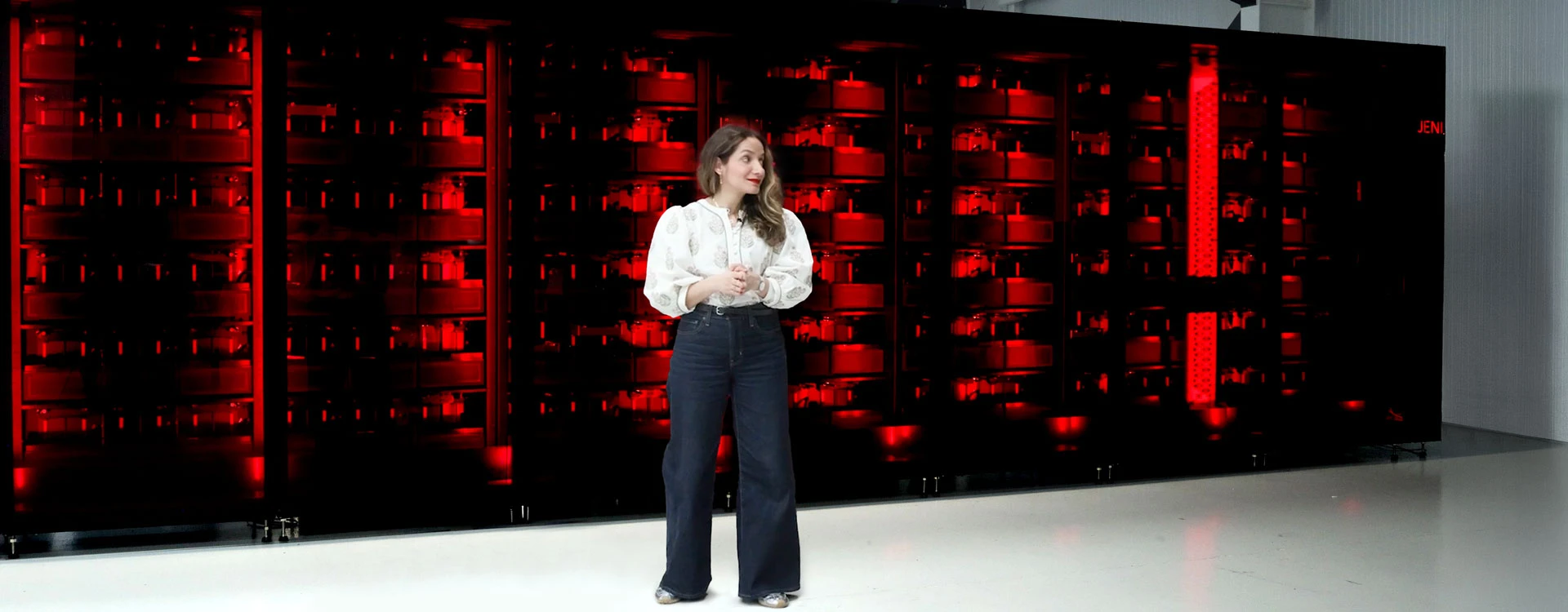
A typical JENI lights-out deployment: the system runs 24/7 in a dedicated room or section of the factory. Resin is supplied from IBCs refilled every few days. The gantry moves platforms between print, wash, cure, and separation stations automatically. A day-shift team handles downstream sorting and packing, sized to match the overnight output. Maintenance is performed based on system alerts, during planned windows. The control system is monitored remotely.
The largest installation — 16 modules with 288 nodes — can produce 148,000 parts per day. A single-module system — about the size of a wardrobe — can produce up to 1.2 million small, accurate parts per day. Both run lights-out. Neither requires an operator standing next to it.
The bottom line
Lights-out resin printing is not a feature you switch on. It is a system architecture — automated material supply, integrated post-processing, reliability engineering, downstream capacity matching, and a data-driven maintenance strategy. When those elements are in place, resin 3D printing runs continuously, unattended, at production scale. When they are not, you have a print farm that needs an operator — which is not lights-out, and not production.
Learn more about how automated resin printing works at industrial scale and the 7-module JENI configuration that delivers 1.2 million parts per shift. For the economic case, see how to calculate production 3D printing cost per part.