For additive manufacturing to compete with injection molding, it needs to solve a throughput problem. A single 3D printer, no matter how good, cannot match the parts-per-hour output of a molding press. Photocentric's response is JENI, a modular, autonomous manufacturing platform that scales not by making one printer faster, but by orchestrating many print nodes as a single, continuous system. The 7-module configuration represents the most capable JENI system to date, and it is worth examining in detail what that means for manufacturers evaluating additive production against molding.
The architecture: 124 nodes, one system
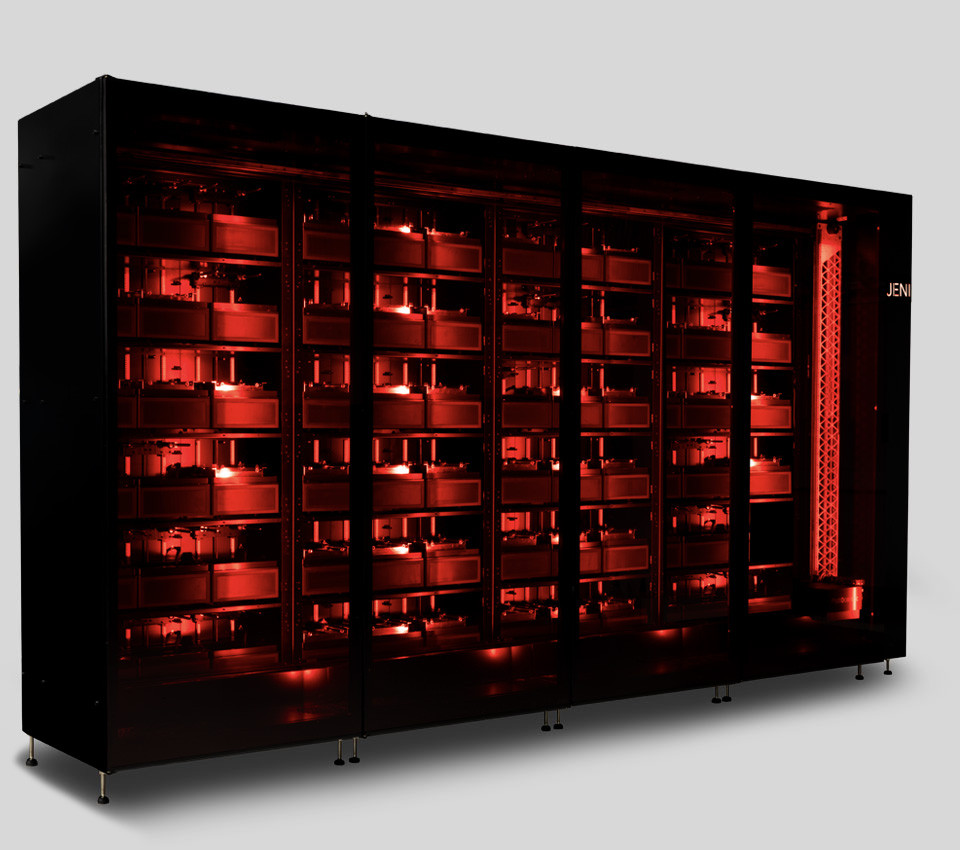
A 7-module JENI system comprises up to 124 individual LCD 3D printing nodes, each offering a build volume of 130 mm by 225 mm with a build height of 57 mm. These are not standalone printers sitting next to each other. They are integrated through a high-speed gantry that moves at 3 meters per second, collecting finished print platforms, delivering them to post-processing nodes, and returning clean platforms to the next free print node — all without human intervention.
The distinction matters. A print farm of 124 individual printers would still require operators to load, unload, wash, and cure parts. JENI eliminates that labor by treating the entire collection of nodes as a single automated production line. Each job carries its own process recipe — wash time, cure time, temperature, layer thickness — so different products can run simultaneously across different nodes without any changeover downtime.
Throughput: what 1.2 million parts per shift actually means
When producing standoffs — a common small plastic component used in electronics assembly — the 7-module system delivers over 1.2 million parts within a single 8-hour production window. To put that in context, a mid-range injection molding press might produce 50,000 to 100,000 small parts per shift, depending on cycle time and cavitation. JENI's output is not just competitive; for the category of small components it targets, it exceeds what many molding cells achieve.
The throughput figure is not a theoretical maximum. It reflects real production data from a configured system running a specific part geometry. Smaller parts with denser platform packing will yield higher counts; larger parts will yield fewer. The point is that the platform scales horizontally — more nodes means proportionally more output — without the step-change in cost and complexity that comes with commissioning a new molding press and tool.
Production density: under 6.1 square meters
Factory floor space is a constraint that rarely appears in headline specifications but dominates real-world manufacturing decisions. The entire 7-module JENI system operates within a footprint of less than 6.1 m². For comparison, a single injection molding press with its material feed, mold storage area, and finished-goods buffer typically requires 15–30 m².
This production density matters for two reasons. First, it means JENI can be installed in facilities where space is at a premium — an existing warehouse, a repurposed room, or a distributed manufacturing site close to the point of demand. Second, it changes the per-square-meter economics. Parts produced per square meter of factory floor is a metric that procurement and operations teams use to compare manufacturing technologies, and JENI is designed to maximize it.
Lights-out operation: the labor equation
JENI runs 24 hours a day, 7 days a week, with no operator present. The system monitors each node, assigns jobs, moves platforms, and adjusts process parameters using machine learning — optimizing for cost, speed, carbon footprint, or quality depending on the priority set for each job. If a node needs attention, the system reroutes work to other nodes and flags the issue for scheduled maintenance.
The labor model for injection molding is fundamentally different. Even a highly automated molding cell needs an operator for mold changes, material changes, quality checks, and machine tending. Over a 24-hour period, that is typically three shifts of labor. JENI eliminates that cost entirely, which is one of the reasons the total cost of ownership for a JENI system is dominated by material cost rather than labor.
Modular scaling: from one module to seven and beyond
One of the structural advantages of JENI's modular design is that a manufacturer does not need to commit to the full 7-module configuration upfront. A system can start with a single control module and one process module, then expand as production demand grows. Each additional module adds print nodes and post-processing capacity, and the gantry system scales to accommodate them.
This incremental investment model is a significant departure from the capital expenditure pattern of injection molding. Scaling a molding operation typically means purchasing an entirely new press, commissioning a new tool, and finding additional floor space. With JENI, scaling means adding a module to an existing system — a lower-cost, lower-risk expansion that can be timed to match demand.
Multiple resins, multiple products, simultaneously
A 7-module JENI system can run a different resin on each print node. In practice, this means a single system might produce rigid engineering components on 40 nodes, flexible seals on 30, and bio-based parts on the remaining 54 — all at the same time, each with its own process recipe. There is no changeover time, no purge, and no material waste when switching between products.
In an injection molding context, running multiple materials requires multiple presses or extended changeover times for purging and mold swaps. The ability to run mixed production simultaneously is one of the reasons JENI is particularly suited to high-mix, medium-volume manufacturing — the kind of production that molding struggles to serve economically because tooling cost is amortized over too few parts per design.
The sustainability angle: 84.9% less CO2e per part
An independent cradle-to-gate study by the Manufacturing Technology Centre found that parts produced on JENI generate 84.9% less CO2e than the same parts produced by injection molding. The saving comes primarily from material — molding wastes considerably more material than the part weighs, through sprues, runners, start-up scrap, and purging. JENI packs platforms densely and returns uncured resin to the vat, so process scrap is minimal by design.
JENI also calculates the embedded carbon of every part it produces, using measured data for material and energy consumption per job rather than a modelled estimate. For manufacturers reporting against sustainability targets or facing carbon pricing, this per-part carbon figure is a direct operational metric, not a reporting overhead.
Who should evaluate a 7-module JENI system
The 7-module configuration is aimed at manufacturers who need more than 5,000 parts per day and who produce small plastic components — typically under 130 mm in their longest dimension. It is particularly relevant for:
- Electronics and electrical — standoffs, clips, connectors, grommets, and insulators produced in high volume with frequent design changes.
- Medical and dental — custom or batch production where multiple resin types and part geometries run side by side on the same system.
- Automotive — bridge manufacturing between design finalization and tool delivery, plus low-volume end-use parts where tooling cost is not justified.
- Distributed manufacturing — placing production close to the point of demand to reduce logistics cost and lead time, enabled by JENI's compact footprint and lights-out operation.
For organizations already running injection molding, JENI is not a replacement for every part — high-volume single-part designs with stable geometry will continue to suit molding. But for the long tail of parts where designs change, volumes are moderate, or tooling cost cannot be justified, the 7-module JENI configuration offers a production route that is faster to market, cheaper to scale, and dramatically lower in carbon.
Next steps
Photocentric's evaluation process begins with understanding your parts — volumes, costs, properties, and support requirements — and providing a comprehensive Total Cost of Ownership and Life Cycle Assessment. If JENI is not transformational for your application, the team will say so. The process moves from evaluation through Factory Acceptance Test and Site Acceptance Test to on-site installation and training, with a lead time of approximately 3 months.
Learn more about how JENI works as injection molding without tooling and the full cost comparison between JENI and injection molding.