Cost per part is the single number that determines whether production 3D printing is viable. If it is lower than the alternatives — injection molding, CNC machining, outsourcing — then additive manufacturing is a production route. If it is higher, it is a prototyping tool. The problem is that most cost-per-part calculations for 3D printing are wrong. They use best-case throughput, ignore hidden costs, or compare against an incomplete picture of injection molding economics.
This article provides a transparent framework for calculating the real cost per part in production 3D printing, with realistic inputs and a worked example. It is written for buyers — procurement teams, manufacturing engineers, and operations leaders — who need to make a defensible decision based on evidence, not vendor claims.
The six cost components
Every production 3D printing cost-per-part calculation should include six components. Omitting any of them produces a number that looks attractive but does not survive contact with a real production floor.
1. Material cost
Material cost is the resin or filament consumed per part, multiplied by the material price per unit. For resin printing, this is: (part volume × resin density × resin price per kg). In JENI, uncured resin is returned to the vat after each print, so the only material consumed is what ends up in the finished part — process scrap is minimal. Parts should be optimized to print without supports. In injection molding, by contrast, sprues, runners, start-up scrap, and purging waste can add 20 to 40% to the material bill.
The key variable is resin price. Photocentric formulates its own photopolymers, which keeps material cost competitive with commodity thermoplastics. Open-material systems that rely on third-party resin suppliers may face significantly higher per-part material costs. Always use the actual price you will pay, not a theoretical price from a datasheet.
2. Machine amortization
Machine amortization is the system cost spread across the parts it produces over its useful life. The formula is: (system cost / expected lifetime parts). For a system producing 1.2 million parts per day over a 5-year lifespan, the per-part machine cost is measured in fractions of a cent. For a standalone printer producing 50 parts per day, it is measured in dollars.
This is where automated systems like JENI have a structural advantage. The system cost is higher than a standalone printer, but the throughput is orders of magnitude higher, so the amortization per part is dramatically lower. The comparison that matters is not printer cost vs. printer cost — it is cost per part vs. cost per part.
3. Energy cost
Energy consumption per part is: (system power draw × cycle time per platform) / parts per platform. For LCD resin printing, energy consumption is low compared to injection molding, which requires heated barrels, high-pressure clamping, and significant startup energy. An independent cradle-to-gate study by the Manufacturing Technology Centre found that parts produced on JENI generate 84.9% less CO2e than the same parts produced by injection molding — a figure driven largely by energy and material efficiency.
Use your actual electricity rate ($/kWh) and the system's rated power consumption. Do not estimate — measure it during a trial build if possible.
4. Labor cost
In standalone resin printing, labor is a major cost component — operators load, unload, wash, cure, and separate parts. In an automated system like JENI, labor is negligible during production. The system runs 24/7 unattended. The only labor is maintenance (scheduled, infrequent) and downstream handling (sorting, packing — which is a separate operation, not a printing cost).
This is the cost component that most standalone-printer calculations understate. If you are running a print farm, count the hours operators spend on post-processing and divide by parts produced. The number is often shocking.
5. Scrap and waste cost
Scrap cost is: (scrap rate × material cost per part) + (failed build cost). In automated resin printing with recipe-driven post-processing, scrap rates are low and consistent. In manual operations, scrap rates vary by operator skill and are often underreported.
Include the cost of failed builds — a print that fails halfway through wastes the material and the machine time. JENI's monitoring and rerouting means a node failure does not waste a full build; the system detects issues early and reroutes.
6. Overhead
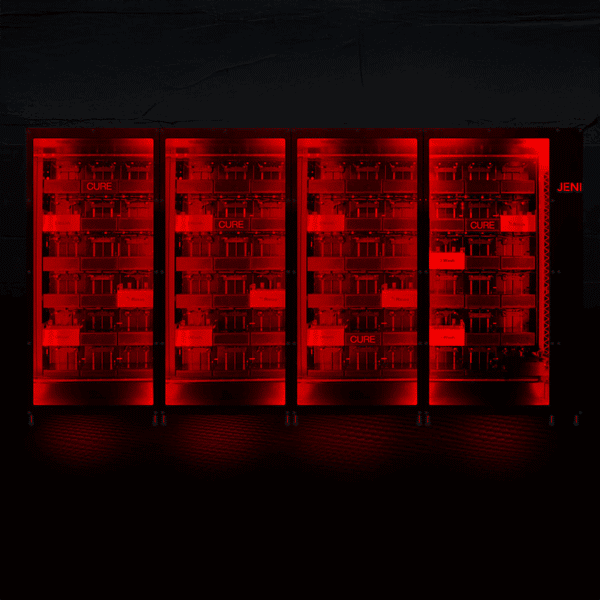
Overhead includes facility costs (floor space, ventilation, utilities), maintenance contracts, software licenses, and quality control. For JENI, the floor space requirement is under 6.1 m² for a 7-module system — a fraction of what an injection molding cell requires. Include this in your comparison.
A worked example
Consider a small plastic standoff — 15mm long, 2 grams — produced on a 7-module JENI system. The following figures are illustrative but use realistic inputs based on actual installations.
- Parts per platform: 780 (dense nesting of small parts)
- Platform cycle time: 20 seconds (print + post-processing in continuous flow)
- Daily output: ~1.2 million parts (single 8-hour shift) or ~3.6 million parts (24-hour lights-out)
- Material per part: 2 grams × resin price. At a production resin price, material cost is a few cents per part.
- Machine amortization: System cost spread across millions of parts per month — fractions of a cent per part.
- Energy: Low power draw per platform, divided across 780 parts — negligible per part.
- Labor: Negligible (lights-out operation).
- Scrap: Minimal (automated, recipe-driven process).
- Overhead: Under 6.1 m² of floor space, minimal facility cost.
The result: a cost per part that is competitive with injection molding for this category of component — without tooling cost, without minimum order quantity, and without the lead time of commissioning a mold.
The injection molding comparison: what to include
A fair comparison must include every cost that injection molding imposes and 3D printing does not:
- Tooling cost: $10,000 to $50,000+ per tool, amortized across the production run. For low-to-medium volumes, this dominates the cost per part.
- Tool storage and maintenance: Molds require climate-controlled storage and periodic refurbishment.
- Design change cost: Any geometry change requires tool modification or a new tool. In JENI, a design change is a new file — no cost, no lead time.
- Minimum order quantity overruns: Molding is economic only above a break-even volume, which means overproducing parts that may become obsolete.
- Part obsolescence: Parts produced to justify a tool run but never used because the design changed. This is a hidden cost that rarely appears in per-part calculations.
- Material waste: Sprues, runners, start-up scrap, and purging can add 20 to 40% to material consumption in molding.
- Labor: Even automated molding cells need operators for mold changes, material changes, and quality checks. Three shifts of labor over 24 hours.
When these costs are included, the cost-per-part gap between automated resin printing and injection molding narrows dramatically — and for many part categories, disappears.
When production 3D printing wins on cost
Production 3D printing wins on cost per part when:
- Parts are small (under 130mm in their longest dimension)
- Volumes are high
- Designs change frequently (tooling amortization period is short)
- Multiple part types are needed (JENI runs them simultaneously with no changeover)
- Tooling cost is high relative to the part's material value
- Floor space is constrained (JENI's production density is higher than molding)
It does not win when parts are large, volumes are extremely high for a single stable design, and tooling is already paid for. In those cases, injection molding remains the right choice. The point is to calculate honestly — for both technologies.
How to get a real number for your parts
The only way to know whether production 3D printing is cost-effective for your specific parts is to run a proper evaluation. Photocentric's evaluation process begins with understanding your parts — volumes, costs, properties, and support requirements — and providing a comprehensive Total Cost of Ownership and Life Cycle Assessment. If JENI is not transformational for your application, the team will say so.
See the full cost comparison between additive manufacturing and injection molding and learn how contract manufacturers could use JENI for low-volume production. For the technology behind automated resin printing, read about automated resin 3D printing for industrial production.