Contract manufacturers live and die by two numbers: lead time and unit cost. Win on both and you keep the customer. Lose on either and the job goes elsewhere. For decades, the economics of low-volume plastic part manufacturing have been straightforward: injection molding for high volumes, CNC or manual methods for everything else, and a gap in the middle where neither is economic. That gap — the long tail of parts where volumes are too low to justify tooling but too high for one-off fabrication — is where contract manufacturers lose money or turn away work.
Autonomous 3D printing changes both sides of that equation. No tooling means no tooling cost to amortize, no tool lead time, and no minimum order quantity. Automated throughput means a cost per part that competes with molding for small components. This article is about where that works, where it does not, and what a contract manufacturer should evaluate before investing.
The problem: tooling economics in low-volume manufacturing
A typical injection molding tool costs $10,000 to $50,000 and takes 6 to 12 weeks to design, manufacture, and validate. For a customer ordering 100,000 parts over the tool's life, the tooling cost adds $0.10 to $0.50 per part — manageable. For a customer ordering 5,000 parts, it adds $2 to $10 per part — often more than the part itself is worth. For a customer who needs 500 parts and might change the design twice, injection molding is simply not an option.
This is the gap contract manufacturers know well. They either turn the job away, absorb the tooling cost to keep the customer relationship, or quote a price the customer will not accept. None of those outcomes is good for business.
How autonomous 3D printing closes the gap
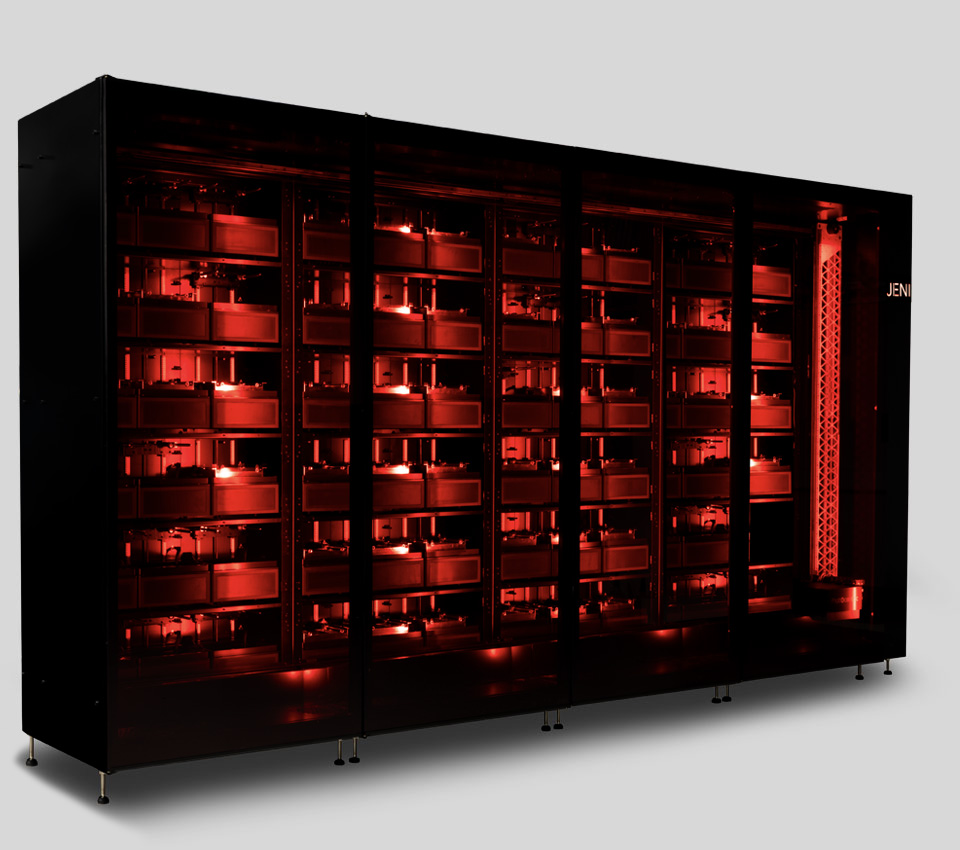
JENI removes tooling from the equation entirely. A digital file is sent to the system; the system prints, washes, cures, and separates the parts automatically; finished parts come out every 20 seconds. There is no tool to design, manufacture, store, maintain, or modify. The cost per part is dominated by material, not by tooling amortization.
For a contract manufacturer, this means:
- No tooling cost in the quote: The price you give the customer is based on material, machine time, and overhead — not on amortizing a $30,000 tool across 5,000 parts.
- No tool lead time: Parts can be in production the day the file is approved, not 8 weeks later when the tool arrives.
- No minimum order quantity: A customer can order 500 parts or 500,000. The system does not care — the cost per part is the same.
- Instant design changes: The customer revises the geometry; the new file runs on the next platform. No tool modification, no cost, no delay.
Where it works: validated use cases
Based on real JENI installations, autonomous 3D printing is a viable production route for contract manufacturers in the following scenarios:
Electronics and electrical components
Standoffs, clips, connectors, grommets, insulators, and spacers — the small plastic parts that every electronic assembly needs. These parts are typically under 40mm, needed in high volume, and subject to frequent design changes as products evolve. A single-module JENI can produce up to 1.2 million of these per day, and the system runs multiple customer jobs simultaneously with no changeover.
Consumer goods small components
Caps, closures, buttons, knobs, and small mechanical components. Consumer products have short life cycles and frequent design iterations, which makes tooling amortization painful. JENI allows a contract manufacturer to serve multiple consumer goods customers on a single system, running different geometries and different resins at the same time.
Bridge manufacturing
When a customer's product is ready for market but the injection molding tool is still 8 weeks out, JENI can produce the parts in the interim — at production quality, at volume. This bridge from design freeze to tool delivery is a service contract manufacturers can offer that adds value without requiring the customer to compromise on timeline.
Distributed and on-demand production
A 7-module JENI occupies under 6.1 m² and runs lights-out. A contract manufacturer can place a system close to a customer's assembly line — in a spare room, a warehouse corner, or a regional facility — and produce parts on demand, eliminating shipping cost and lead time. This is particularly valuable for customers with geographically distributed operations.
Where it does not work
Honest evaluation means knowing the limits. Autonomous 3D printing is not the right answer for:
- Large parts: JENI's build envelope is 130mm × 225mm × 57mm. Parts larger than this cannot be produced in a single build.
- Ultra-high-volume single-design parts: If a customer needs 10 million identical parts per month with a stable design and the tool is already paid for, injection molding will win on cost per part.
- Materials outside the photopolymer range: JENI runs resin — not thermoplastic pellets, metal, or ceramic. If the part requires a specific engineering thermoplastic that has no photopolymer equivalent, molding or CNC may be the only option.
- Parts requiring specific molding-only properties: Some parts require the crystalline structure or fiber reinforcement that only injection molding of engineering thermoplastics can provide. Photopolymers are advancing rapidly but are not yet a universal substitute.
The right approach for most contract manufacturers is not either/or — it is both. Use injection molding for stable, high-volume, single-design parts where the tooling is justified. Use JENI for the long tail of low-volume, changing-design, time-sensitive jobs that molding cannot serve profitably.
Job aggregation: the business model advantage
One of the most powerful aspects of JENI for contract manufacturers is job aggregation. Because the system runs multiple part types simultaneously with no changeover, a contract manufacturer can run several customer jobs on a single system in the same shift. Customer A needs clips, customer B needs connectors, customer C needs caps — all run together, each with its own process recipe, on the same 124-node system.
This changes the economics. A single JENI system does not need one big customer to justify its cost — it needs a portfolio of small-to-medium jobs that collectively keep the system fed. For a contract manufacturer with a diverse customer base, that portfolio already exists.
Evaluating JENI for your contract manufacturing operation
The evaluation process for a contract manufacturer should answer three questions:
- Do your customers' parts fit? Are they under 130mm, small plastic components, needed in high volumes (aggregated across customers)?
- Does the cost per part compete? Run a proper TCO comparison against injection molding for representative jobs, including tooling, lead time, and obsolescence costs. See our cost-per-part calculation framework.
- Can you feed the system? Do you have enough customer jobs in the low-to-medium volume range to keep a JENI system utilized? Job aggregation across customers is the key to utilization.
Photocentric's evaluation process begins with understanding your parts and customer base, then providing a comprehensive Total Cost of Ownership and Life Cycle Assessment. If JENI is not the right fit for your operation, the team will say so. The process moves from evaluation through Factory Acceptance Test and Site Acceptance Test to on-site installation and training, with a lead time of approximately 3 months.
The bottom line
For contract manufacturers, the value proposition is simple: win jobs you currently lose on tooling cost, serve customers you currently turn away, and offer lead times your molding-only competitors cannot match. Autonomous 3D printing is not a replacement for injection molding — it is a new capability that fills the gap where molding economics break down. For the contract manufacturer willing to invest, that gap is where the profitable work has always been.
Learn how to calculate production 3D printing cost per part and how JENI works as injection molding without tooling. For the technology behind it, see automated resin 3D printing for industrial production.